

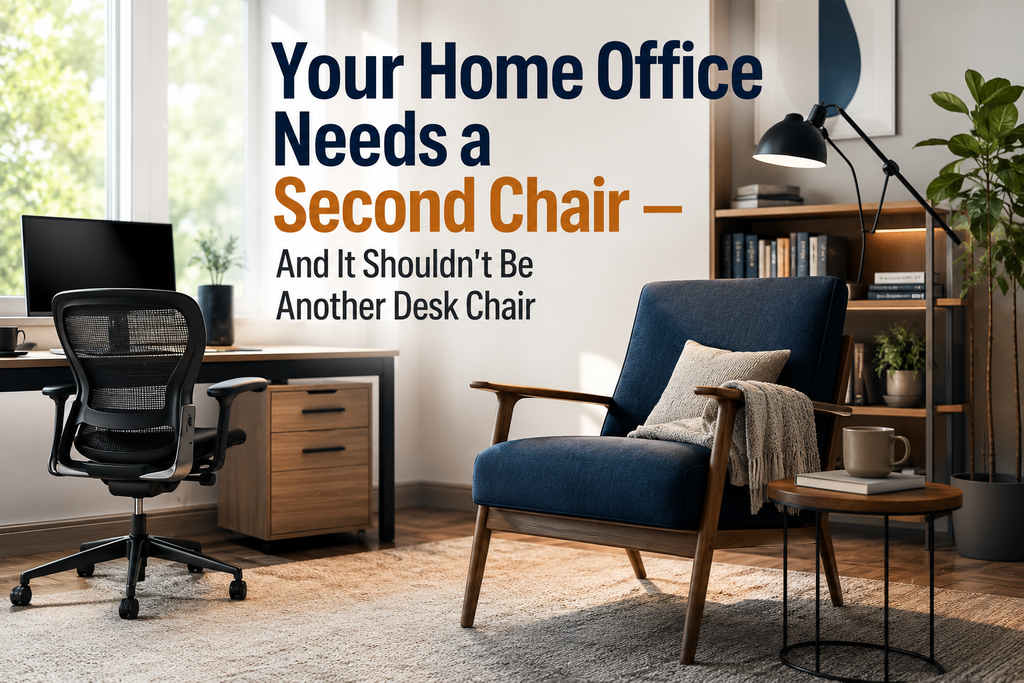
Most people who work from home solve the seating question once. They buy a decent task chair, put it at the desk, and consider the matter closed.
Then they spend nine hours a day in it, and by month four they’ve developed the specific lower-back stiffness that comes from holding one position for too long, too often.
The problem isn’t the chair. A good task chair is a good task chair. The problem is that a home office with exactly one seat forces every kind of work into exactly one posture — and the human body isn’t built for that, no matter how well the chair is designed.
The Issue Is Variation, Not Comfort
Ergonomics conversations tend to focus on finding the correct sitting position, as though there’s one right answer to be discovered and then maintained.
There isn’t. Even a perfectly adjusted posture becomes a problem when it’s the only one you hold. Static loading is what causes the stiffness the same muscles supporting the same position for hours, without the small shifts that keep circulation moving.
The practical implication is that the second chair matters more than upgrading the first one. Moving between two different seated positions across a day does more for how your back feels at 6pm than any amount of lumbar adjustment on a single chair.
Aim to change position roughly every 45 to 60 minutes. Not necessarily to stand — just to sit differently.
Match the Chair to the Kind of Work
Not all desk work is the same work, and this is the part most home office setups miss.
Typing and precision work needs the task chair. Feet flat, back supported, forearms roughly parallel to the floor, screen at eye level. This is what task chairs are engineered for, and nothing else does it as well.
Calls and meetings don’t need any of that. You’re listening and talking, not manipulating a keyboard. A more open, reclined posture is genuinely better here — it’s easier to breathe in, which affects how you sound, and video calls look better from a slightly reclined angle than from the hunched-over-keyboard position.
Reading, reviewing and thinking are actively worse at a desk. There’s reasonable ground for the idea that changing physical context changes how you approach a problem, and most people recognise the experience: you read the same document differently in an armchair than you do at the desk where you’ve been answering email.
Three types of work, and only one of them actually requires the task chair.
Armchair, Lounge Chair or Recliner?
These get used interchangeably and they’re meaningfully different pieces.
An armchair has a fairly upright back usually 100 to 110 degrees and a seat height similar to a dining chair. You can get up from it easily and you can hold a laptop or a document without sliding down. For a working second seat, this is almost always the right answer.
A lounge chair sits lower and reclines further, often 110 to 120 degrees, with a deeper seat. Excellent for reading a book for an hour. Poor for anything involving a screen, because the angle pushes your head forward to see it.
A recliner is a rest chair. It’s the wrong tool entirely for a working environment, and it takes considerable floor space to open.
If you’re planning a corner that has to work for both an evening and a workday, browsing the general armchairs for living room range rather than office furniture specifically will give you far better options. The piece you want is a living room chair that happens to be in a workspace — not an office chair pretending to be comfortable.
The Measurements That Matter
For a chair you’ll actually work from, four numbers decide whether it succeeds.
Seat height: 40–45 cm. Low enough to be restful, high enough that you can stand up without pushing off the arms. Below 38 cm and getting out of it becomes a small event, which means you’ll use it less.
Seat depth: 50–55 cm. Deep enough to be comfortable, shallow enough that your lower back reaches the backrest with your feet still on the floor. If you have to choose between a cushion behind your back and your feet dangling, the seat is too deep.
Back angle: 100–110 degrees. Open enough to be a genuine change from your desk posture, upright enough to hold a laptop or read without sliding down.
Arm height: 18–22 cm above the seat. This is the one people never check and then notice constantly. Arms at the right height support your elbows while you hold a book or a tablet. Too low and your shoulders drop; too high and they hunch.
Placing It in a Small Apartment
Most people setting this up don’t have a spare room. A few things make it work anyway.
Angle it away from the desk. Facing a different direction than your working position is the point. If the chair looks at the same wall as the desk, the context doesn’t change and you won’t use it differently.
Watch what’s behind you. If you’ll take video calls from it, check what the camera sees. A blank wall or a bookshelf works; an open kitchen doesn’t.
Get the light right. Window in front of you or to the side, never behind — backlighting turns you into a silhouette on every call. This is worth more than any camera upgrade.
Corners are underused. A chair angled into a corner takes remarkably little usable floor space and creates a defined zone without any partition or divider.
Add a small table. Somewhere to put a coffee, a phone and a notebook. Without one, the chair becomes a place you sit for five minutes before returning to the desk.
Buying an Armchair in Lebanon
Remote work for overseas clients has become a normal arrangement for a lot of people here, and it’s usually happening in a shared family apartment rather than a dedicated office. That makes the second chair more valuable, not less — it’s often the only way to mark a working zone in a room that has other functions.
Two local notes worth factoring in.
Fabric choice matters more in a humid climate. Coastal apartments run humid for much of the year. Tightly woven fabrics and treated finishes handle it better than loose weaves, which hold moisture and take longer to dry out after summer.
See the seat depth in person. It’s the dimension that photographs least usefully and matters most for a chair you’ll work from. Sit in it for longer than the polite thirty seconds, sit as though you’re on a call, for a couple of minutes.
Pricing is not the obstacle people expect. A reasonable armchair Lebanon buyer can find locally runs from roughly $110 up to about $260, which puts a well-chosen second seat well below the cost of most decent task chairs.
Four Things to Check Before Buying
- Frame construction. Solid wood or welded metal. Test by lifting one front corner slightly a well-built frame comes up as one piece with no flex or creak.
- Cushion recovery. Press down hard and release. Good foam returns almost immediately. Foam that stays compressed will be flat within a year.
- Fabric durability. Ask about the rub count if the retailer knows it. Anything above 20,000 handles daily use; below 15,000 is for occasional seating.
- Arm construction. You’ll push off them every time you stand. Pressing down firmly on one arm any movement or creaking is a problem that gets worse.
