

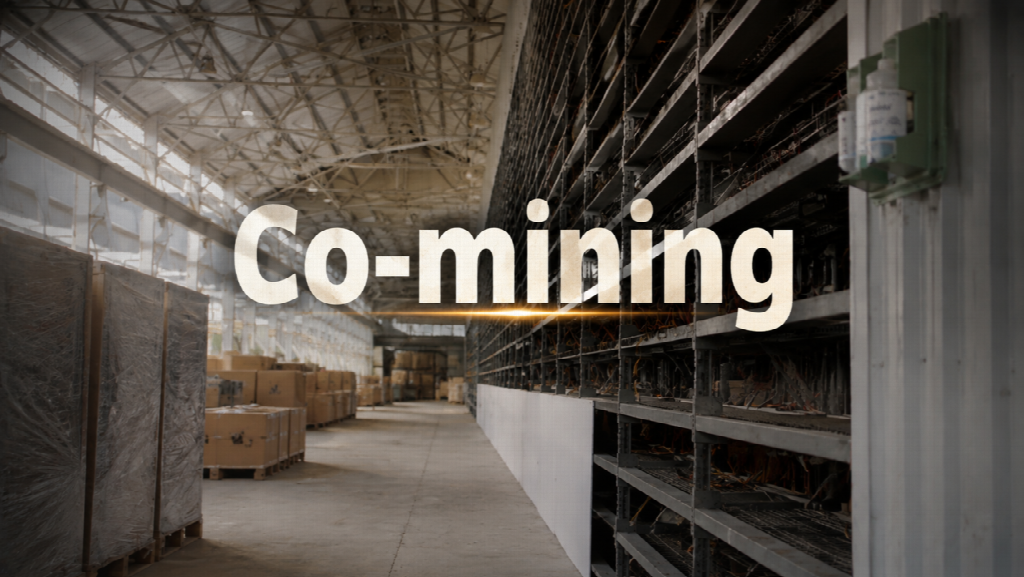
Bitcoin mining after the halving has created a sharper capital-allocation problem for site owners. Low-cost electricity and ready infrastructure remain valuable, but running that power at competitive margins increasingly requires newer ASICs. In Q2 2026, global hashrate averaged about 1,004 EH/s, down 5.8% quarter on quarter, while historically low hashprice pushed many older, high-consumption machines offline. For a site owner, buying a modern fleet means another large capital outlay plus the risk that the hardware loses economic value as more efficient generations arrive. Co-Mining offers a different structure: the site partner can contribute power and infrastructure without funding the miner fleet, reducing upfront investment and direct hardware depreciation exposure while still participating in mining profit.
The Heavy-Asset Model Concentrates Too Much Risk
Traditional self-funded mining puts nearly every major commitment on the site owner. The operator secures land, power capacity, permits and grid access, then purchases miners, builds supporting systems and carries the equipment through its useful life.
That model provides maximum control, but it also ties capital to assets that can become less competitive quickly. The efficiency bar is moving fast: new-generation hydro-cooled ASICs have already reached below 10 J/TH. When more efficient equipment enters the market, older fleets face higher electricity cost per terahash, lower operating margins and weaker residual value.
For a company whose real advantage is access to low-cost megawatts, owning every generation of mining hardware may therefore be an inefficient use of capital.
Co-Mining Changes Who Pays for the Machines
Co-Mining does not change the core economics of Bitcoin mining. It changes which party owns the depreciating hardware.
Bitdeer’s Co-Mining framework is one example. The site partner provides a locally compliant facility, available power capacity and grid connection. Bitdeer supplies the mining hardware and brings deployment and operating capabilities. Net profit is then shared according to the agreed contract terms. Typical project requirements start at 15 MW for air-cooled deployments and 5 MW for hydro-cooled deployments, with projects assessed individually.
The practical difference is straightforward:
| Economic Factor | Traditional Self-Funded Mining | Co-Mining |
| Site & Power Infrastructure | Site owner | Site partner |
| Miner Purchase | Site owner | Bitdeer |
| Direct Hardware Depreciation | Borne entirely by Site Owner | Bitdeer carries hardware ownership exposure |
| Capital Tied to Miners | High | Minimal for Site Partner |
| Mining Income | Retained by operator | Net profit shared by agreement |
| BTC Price & Difficulty Risk | Remains | Remains (Shared) |
For the site partner, the attraction is not that mining becomes risk-free or capital-free. The advantage is narrower and more practical: there is no need to finance the miner purchase, direct ASIC depreciation risk shifts to the hardware provider, and the site owner can still earn a share of mining profit.
Why This Matters for Power-Rich Sites
For operators that already control qualified power and usable infrastructure, Co-Mining can convert those assets into mining revenue without turning the site owner into a recurring hardware investor. Capital that would otherwise be locked into ASIC purchases can remain available for substations, electrical upgrades, cooling, site expansion or other infrastructure with a longer useful life.
The model is already being deployed at industrial scale, showing that shared mining capacity can operate far beyond pilot-project size. Scale, however, should not be confused with guaranteed returns. Project economics still depend on electricity prices, uptime, curtailment, Bitcoin prices, network difficulty and the final profit-sharing structure.
What Co-Mining Does — and Does Not — Solve
Co-Mining mainly addresses hardware ownership and capital allocation. It does not eliminate exposure to Bitcoin market cycles, network difficulty or operational performance.
That distinction matters. A site with expensive or unreliable electricity does not become competitive simply because another party owns the miners. But a site with structurally attractive power can avoid adding a second risk layer: repeatedly buying ASIC fleets that may depreciate faster than the underlying power infrastructure.
For power owners, this creates a clearer division of responsibilities. The site partner focuses on the asset it controls best — power, land and infrastructure — while the mining operator manages hardware deployment, fleet performance and replacement cycles.
Final Thoughts
Post-halving mining economics are making capital efficiency as important as energy efficiency. Cheap power remains a competitive advantage, but that does not automatically mean the power owner should also finance and own the machines connected to it.
Co-Mining provides a more asset-light route for qualified sites: lower upfront hardware investment, less direct exposure to ASIC depreciation, and participation in mining profit under an agreed sharing model. It will not suit every project, and it does not remove Bitcoin or difficulty risk. However, as the margin squeeze accelerates post-halving, the decoupling of power infrastructure from ASIC ownership is no longer just an alternative — it is becoming an increasingly important benchmark for smart capital allocation in 2026.
