

For this review I tested SpaceProxy for CDN verification as a practical observation layer for CDN and cache verification. When a site uses a global CDN, two visitors opening the same URL can receive content from different edge locations, cache states, or regional variants. A deployment can look perfect from the developer office while one country still sees an old JavaScript bundle, a stale image, the wrong language, or a redirect cached longer than expected. My goal was to build a repeatable workflow for checking public content from selected markets without pretending that a proxy is a full CDN monitoring platform.
I focused on fixed IPv4/IPv6 endpoints, country and city selection, browser verification, the provider’s diagnostic tools, and a simple method for comparing cache-related headers and visible page output. I did not claim edge latency benchmarks from a short test. For CDN work, the useful question is whether the same URL, under a documented market and browser state, returns the expected asset, status, and version.
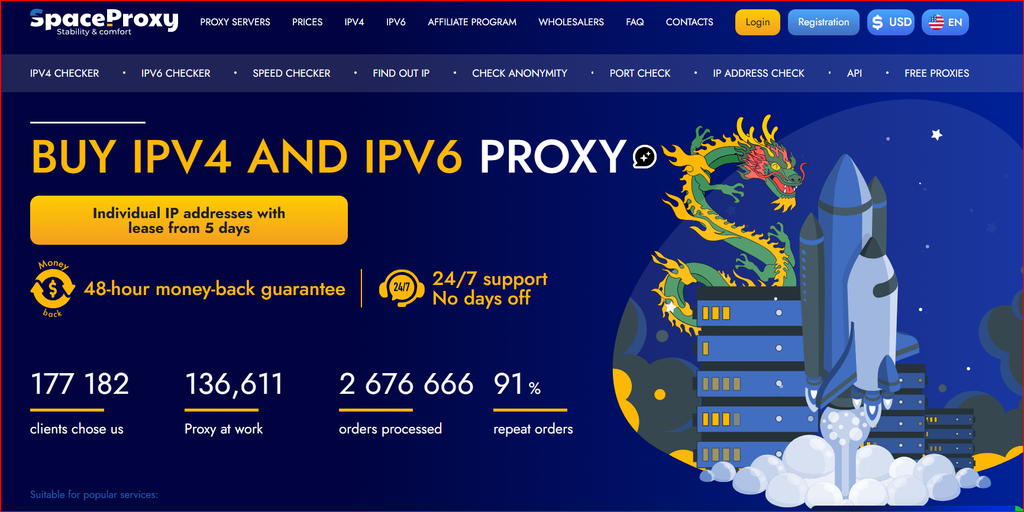
SpaceProxy homepage screenshot used during this September 2026 CDN and cache-verification review.
How I Tested CDN Behavior
I created a small set of URLs: homepage HTML, a versioned JavaScript bundle, a CSS file, a hero image, and one API response that was safe to request publicly. For each target market I connected through a labeled endpoint, verified the visible IP, opened the asset, and captured response headers such as Age, Cache-Control, ETag, Last-Modified, Via, and any CDN-specific cache status when exposed. I also recorded the final hostname because some stacks redirect users to regional domains.
The test becomes much more useful when it is repeated after a purge or deployment. If one market returns the new asset while another still serves an older ETag or Last-Modified value, the team has evidence that the problem is cache propagation or routing rather than application code. The proxy does not explain the root cause, but it gives the CDN or hosting team a reproducible external viewpoint.
Fixed Proxies vs Rapid Rotation
For cache debugging I prefer fixed endpoints. Rotating aggressively can make results harder to compare because each request may hit a different network path. A stable address lets me rerun the same market check several times while a purge or configuration change is being applied. Individual IPv4 is the clearest choice for that kind of debugging, while shared IPv4 can be fine for broader spot checks where exclusivity is not critical.
The goal is not to force a specific CDN edge. Providers decide routing based on their own topology, Anycast, ISP peering, and other signals. The proxy simply gives me a consistent external location from which to observe what the CDN chooses to serve.
Cache-Control, ETag and Asset Versioning
I pay particular attention to versioned assets because a common failure is deploying new HTML that references a new file while an old cached file or service-worker state remains somewhere in the path. For each market I compare the requested URL, status code, cache headers, file size, and a checksum when that is appropriate. If the asset is content-hashed, the expected filename itself becomes a strong indicator.
For HTML, I avoid overinterpreting the Age header because dynamic pages and edge-side logic can behave differently. Instead, I combine headers with a visible version marker or release identifier. A small build ID in the page source or a response header can save hours when diagnosing “some users still see the old site.”
Geo Content and Redirect Caching
Regional redirects can become dangerous when they are cached with the wrong key. A redirect intended for one market may leak into another if cache variation is misconfigured. I tested the workflow by opening the same neutral URL from multiple endpoints and recording the final destination, status code, language, and currency. I repeated the test in a clean browser state to reduce cookie-based noise.
If the site uses a Vary header or geo cookie, I note that in the test record. The best result is a bug report that tells the CDN team exactly which URL, market, endpoint, headers, and final destination were observed. That is far more actionable than “the redirect sometimes looks wrong.”
Using IPv6 as a Second Network Path
SpaceProxy offers IPv6 options at a much lower price than individual IPv4. For a dual-stack site, I would use that as a separate test path. A CDN can have different routing, firewall, and geolocation behavior over IPv6, so a healthy IPv4 result does not prove the IPv6 experience is healthy.
I keep the results separate instead of merging them into one pass/fail. If a market works on IPv4 but not IPv6, the distinction immediately narrows the investigation to DNS, routing, edge configuration, or network policy rather than application content.
Diagnostic Tools and API Use
SpaceProxy publishes checker tools and an API alongside the proxy service. In practice, I would use the tools to validate the endpoint before blaming the CDN. A simple sequence is: verify IP, confirm country, request a known uncached asset, then test the production URL. That separates proxy connectivity from cache behavior.
For repeatable authorized checks, an API can help manage endpoint inventory or feed a QA runner. I would still keep request rates conservative and avoid turning CDN verification into load testing. If performance benchmarking is required, it should be done with a purpose-built test plan and explicit authorization.
Pricing Snapshot
SpaceProxy publishes short rental terms and clear per-IP pricing. The table below reflects the current English pricing page for the lowest quantity bracket and is useful for estimating a small QA matrix. Because prices can change by quantity, country, and term, I would confirm SpaceProxy proxy pricing before purchasing a larger pool.
| Proxy type | 5 days | 30 days | 90 days | 360 days |
|---|---|---|---|---|
| IPv4 Shared | $0.67 | $0.99 | $2.97 | $11.88 |
| Individual IPv4 (1-20) | $0.96 | $1.77 | $5.31 | $21.24 |
| IPv6 /32 (1-99) | $0.10 | $0.51 | $1.53 | $6.12 |
What I Liked
The combination of fixed endpoints, city or subnet selection, diagnostic tools, short rental terms, and an API is well aligned with CDN troubleshooting. I also like that IPv6 can be added as a low-cost compatibility dimension rather than consuming the same budget as dedicated IPv4 everywhere.
For a distributed engineering team, the workflow is easy to document: one market, one endpoint label, one URL set, one expected release. That structure is more important than raw proxy volume because cache bugs are usually about reproducing a specific mismatch.
Limits and Things I Would Monitor
A proxy is not the same as a real last-mile user connection, and it does not guarantee which CDN edge will be chosen. I would therefore combine these checks with CDN logs, origin logs, synthetic monitoring, and analytics. I would also watch for browser caches and service workers, which can make an edge look stale when the stale copy is actually local.
For long-running operations I would maintain a small endpoint-health list and replace addresses that no longer represent the intended test market accurately. Geo databases change, and the test process should verify the visible location every time.
FAQ
Q: Can SpaceProxy tell me which CDN edge served the request? Only if the CDN exposes that information in headers or DNS. The proxy gives you the external market, not internal CDN topology.
Q: Should I use shared or individual IPv4? Individual IPv4 is better for repeatable debugging. Shared IPv4 is adequate for broad spot checks where the exact endpoint history matters less.
Q: Is IPv6 worth testing? Yes for dual-stack sites. Treat it as a separate network path because routing and policy can differ from IPv4.
Q: Can I use the workflow after a cache purge? Yes. That is one of the most useful moments to rerun the same URLs from the same markets and compare headers, assets, and redirects.
Conclusion
After testing this workflow, I see SpaceProxy as a practical companion for CDN and cache QA when the team needs repeatable external observations from several markets. It will not replace CDN logs or a monitoring platform, but fixed geo endpoints, IPv4/IPv6 options, and diagnostic tools can make stale-content and redirect issues easier to reproduce. Before each new project, I would confirm current plans and locations on the SpaceProxy English website.
