

For this review, I tested ProxyStores for international checkout QA as the geo-network layer for an international checkout and shipping QA workflow. The purpose was not to place unauthorized orders or bypass merchant controls. I wanted to verify public shopping behavior that legitimately changes by market: currency, tax wording, shipping availability, region-specific delivery notices, storefront redirects, and the point at which a store asks for a postal code or address. Global commerce teams often discover these issues late because developers test from one country while customers arrive from many.
I paired one browser profile with one market and one fixed endpoint, then documented the visible country, storefront domain, currency, cart behavior, shipping estimator, and any region-specific message. The proxy gives only the network-location signal. I kept account, address, cookie, and language variables separate so I could tell which rule actually changed the experience.
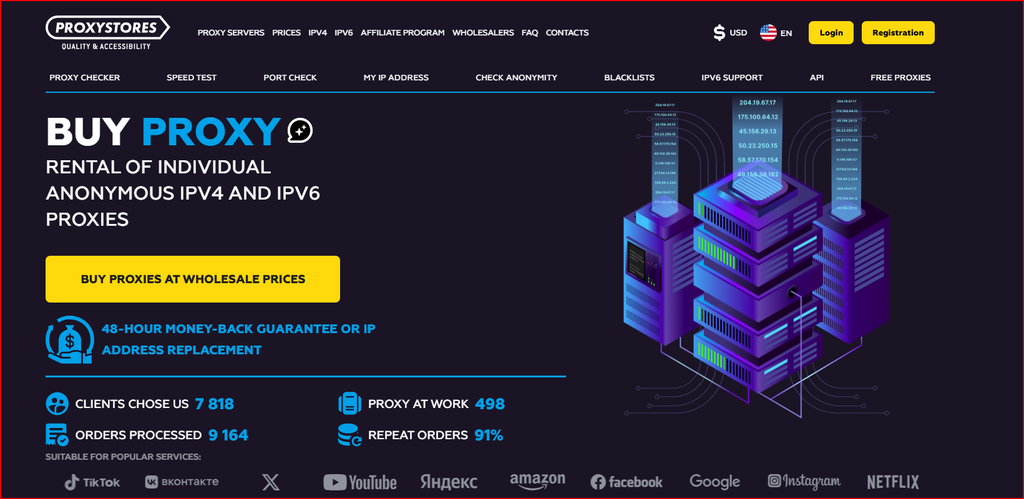
ProxyStores homepage screenshot used during this September 2026 checkout and shipping-QA review.
How I Structured the Checkout Test
I used a safe test product and stopped before a real charge. The flow was: open the product page, add the item to cart, confirm currency, open the shipping estimator or pre-checkout page, enter an approved test postal code if the merchant supports it, and record the resulting delivery options and taxes. For stores with regional storefronts, I also recorded the redirect chain and final hostname.
This matters because checkout bugs often come from the intersection of systems. A proxy can put the browser in a target market, but the shipping result may still depend on the entered address, inventory location, customer account, payment method, or tax engine. A good QA log therefore captures each variable instead of assuming the IP explains everything.
Why Fixed Individual IPv4 Helps
I prefer individual IPv4 for reproducing checkout issues because the same endpoint can be reused while a developer or commerce platform team investigates. If a shipping option disappears only from one market, a fixed IP makes it easier to repeat the scenario without introducing an unrelated network change. Shared IPv4 remains useful for lower-cost smoke tests where the goal is simply to see whether the regional storefront loads and basic cart functions are available.
The value is stability, not stealth. E-commerce systems may treat datacenter proxies differently from normal consumer traffic, so I would not interpret every challenge page as a production customer problem. The test should focus on the store’s authorized QA objectives and use the proxy as one controlled observation point.
Currency, Tax and Regional Storefront Logic
I first confirm whether the storefront itself changes. Some merchants use country subdomains, some keep one domain and switch currency, and others wait until checkout. I log the final URL, currency code, product price, tax label, and any message such as “tax included” or “tax calculated at checkout.” If a region has a legal requirement for a particular notice, that notice becomes part of the expected test result.
I also check that canonical or language navigation still makes sense after a geo redirect. A store can be commercially correct but technically messy if regional routing creates loops or prevents a user from changing country. The test record should include whether the market selector can override the automatic decision and whether that choice persists appropriately.
Shipping Availability and Delivery Estimates
Shipping QA is where a market-level proxy and an address-level test must be distinguished. A proxy can help verify which storefront or generic shipping message appears before an address is entered. The actual carrier options usually depend on the delivery address. I therefore record both stages separately: pre-address messaging and post-address estimate in an authorized test environment.
For restricted products, I check that the public catalog gives a clear message instead of letting a shopper progress deep into checkout before failing. A clean regional test can reveal inconsistent restrictions, missing translations, or a promotion that claims delivery where the fulfillment system later rejects it.
IPv4 and IPv6 Coverage
ProxyStores offers both IPv4 and IPv6 products. For commerce QA, IPv4 remains the broad compatibility baseline because virtually every storefront supports it. IPv6 is useful as a second path for sites that advertise dual-stack support. I would not mix the two results because a CDN, WAF, or geolocation provider can handle them differently.
An IPv6-only failure is worth investigating even if most shoppers still use IPv4. It can point to a missing security rule, route, or geo record. At the same time, I would avoid spending a large QA budget on IPv6 markets until the store’s real traffic and infrastructure justify that coverage.
HTTP/SOCKS5 and Test Tools
For manual browser checks, conventional proxy support is enough to keep one profile tied to one market. For scripted QA, I would validate the endpoint with a simple request before launching a browser automation stack. Credentials belong in a secret store, not in code or shared spreadsheets.
I also keep an explicit request-rate limit. Checkout and shipping QA should be lightweight. If the team needs performance or load testing, it should use a staging environment or a formally approved production test plan rather than sending large traffic through geo proxies.
Pricing Snapshot
The published price table makes it inexpensive to build a small market matrix. The figures below reflect the lowest quantity bracket on the current English pricing page. Because quantity and rental duration can change the unit cost, I would verify ProxyStores pricing again before a larger international rollout.
| Proxy type | 5 days | 30 days | 90 days | 360 days |
|---|---|---|---|---|
| IPv4 Shared | $0.67 | $0.99 | $2.97 | $11.88 |
| Individual IPv4 (1-20) | $0.96 | $1.77 | $5.31 | $21.24 |
| IPv6 /32 (1-99) | $0.10 | $0.51 | $1.53 | $6.12 |
| MTProto (1-20) | $0.96 | $1.77 | $5.31 | $21.24 |
What I Liked
The strongest fit is the combination of fixed endpoints, clear short-term pricing, both IPv4 and IPv6, and support for selecting location details. For checkout QA, that supports a disciplined market-by-market process without forcing the team to buy a large rotating pool. I also like that a 5-day term is long enough for a focused regression cycle while remaining inexpensive.
The workflow is also easy to hand to non-network specialists. A QA person can follow a checklist, capture the visible market and checkout state, then share a concise bug report with commerce, tax, localization, or fulfillment teams.
What I Would Monitor
I would verify the visible country before every test and avoid assuming an old endpoint still maps exactly as expected. I would also maintain approved test addresses and products so the team does not accidentally create real orders or interfere with inventory. Any checkout that reaches payment should use the merchant’s documented sandbox or test method.
Over time, I would track false positives caused by personalization, cookies, and account history. A region-specific result should be reproduced in a clean profile before it becomes a production incident. That simple step prevents the proxy from becoming a scapegoat for unrelated application state.
FAQ
Q: Can ProxyStores verify final shipping prices by itself? No. The proxy provides network location. Final shipping usually depends on the entered address, product, carrier rules, and account state.
Q: Should I choose individual or shared IPv4? Individual IPv4 is better for reproducible debugging. Shared IPv4 can be sufficient for broad storefront smoke tests.
Q: Can I test IPv6 checkout? Yes if the storefront supports IPv6. Keep it as a separate compatibility result.
Q: Is it safe to automate checkout QA? It can be, if the merchant authorizes it and the test stops before real transactions unless a sandbox or approved test payment method is used.
Conclusion
After testing the workflow, I see ProxyStores as a useful network layer for international checkout and shipping QA when the team needs stable market viewpoints at a predictable cost. It does not replace test addresses, tax rules, fulfillment logic, or payment sandboxes, but it can make regional storefront and pre-checkout differences much easier to reproduce. I would confirm current locations and terms on the ProxyStores English website before each new test cycle.
