

For this review, I tested ProxyLine proxies for e-commerce QA as the network layer for an e-commerce catalog QA workflow. The goal was not to automate purchases or create artificial activity. I wanted to see how a fixed proxy can help a QA or merchandising team confirm that public product pages show the correct price, stock message, currency, regional banner, language, tax note, and delivery promise from selected markets. E-commerce localization is easy to underestimate because a catalog page may look correct from headquarters while a visitor in another country sees a different currency, an unavailable SKU, a geo redirect, or a promotion that should not appear there.
I approached the test as a reproducibility problem. One browser profile was paired with one labeled market and one proxy endpoint. I recorded the target URL, visible IP country, browser language, cookie state, final URL, displayed currency, product price, availability message, and shipping text. That gave me a repeatable record that could be rerun after a product-feed change or a localization fix. I did not claim that an IP address alone reproduces every real shopper experience; account state, device, cookies, CDN logic, and application rules can also change the page.
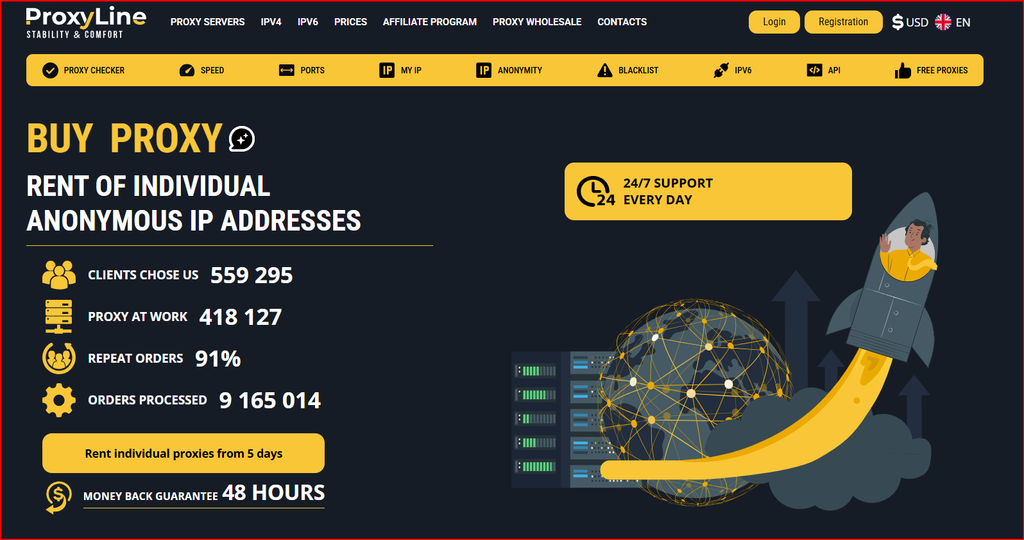
ProxyLine homepage screenshot used during this September 2026 catalog-QA review.
How I Tested the Catalog Workflow
I built a compact test matrix covering five typical scenarios: a product that is sold everywhere, a product blocked in one market, a product with regional pricing, a product with a localized promotion, and a product whose shipping estimate changes by country. Before opening the product page, I verified the endpoint and cleared the browser profile. I then captured the product title, price, stock status, shipping line, currency, and any redirect that occurred. If the same URL produced different outcomes across markets, I documented the exact endpoint and browser profile so the team could reproduce the difference.
The most useful part of this approach was consistency. If a catalog bug is reported as “the German price is wrong,” a developer needs more than a screenshot. A structured test case should say which market, IP, language, URL, cookie state, and time were used. A fixed endpoint makes that handoff easier because the QA person can rerun the same conditions after the code or feed is updated instead of introducing a new network identity on every retry.
Dedicated IPv4 vs Shared IPv4 for Product QA
For high-priority markets I prefer individual IPv4 because the endpoint remains assigned to one customer during the rental window. That reduces one variable when a team is comparing before-and-after behavior. Shared IPv4 can still be useful for lower-cost public catalog checks, especially when the task is simply to confirm that a page opens and the correct regional copy appears. I would not mix dedicated and shared endpoints inside the same bug report unless the difference itself is being tested.
Dedicated does not mean invisible, residential, or automatically trusted by every website. The main benefit in this workflow is repeatability. If a site displays a challenge page or blocks a request, I would first inspect the request pattern and site rules rather than assuming the fix is to rotate identities. E-commerce QA benefits more from stable, documented conditions than from aggressive rotation.
Regional Pricing, Currency and Tax Checks
Price localization can fail in subtle ways. A product may show the correct currency symbol but the wrong numerical price, or a catalog feed may update one region hours later than another. I tested the workflow by comparing a baseline price matrix with what the public product page displayed from each market. I also recorded whether VAT or sales-tax wording appeared where expected. For global stores, I would store the expected region, currency code, price source, and tolerance rule so a small rounding difference is not confused with a major pricing error.
Promotions need similar discipline. A banner may be geo-targeted while the product price itself is global, or a campaign may apply only after a cookie is set. I would test both a clean session and a returning session when that distinction matters. The proxy provides the network location; it does not replace campaign logic, consent state, or account-level rules.
Stock, Availability and Shipping Messages
Catalog QA should include availability text because fulfillment rules can be regional. The same SKU can be in stock globally but unavailable for delivery to one country. I used the proxy market as the first check, then treated postal code or account address as a separate variable if the site required it. The test record should distinguish “not sold in this country” from “not deliverable to this postal code,” because those are different business rules and usually owned by different systems.
Shipping estimates deserve their own capture. A page may render a generic delivery promise before checkout and a more precise one later. I would not push a public QA workflow through a real purchase unless the merchant has an approved test environment. For production sites, confirming the public product page, delivery estimator, and pre-checkout messaging is usually enough to detect catalog-localization regressions without creating unnecessary orders.
SOCKS5, HTTP and Browser Tooling
ProxyLine provides proxy formats that can fit browser profiles and tools that accept standard proxy credentials. For manual QA I prefer a browser profile because screenshots, cookies, and locale settings remain easy to manage. For lightweight automation, HTTP or SOCKS5 support can be useful if the test runner is authorized to access the target. The important practice is to keep credentials out of source code and use environment variables or a secure secret store.
I also separate network testing from application automation. First I confirm that the endpoint works with a simple browser or request. Only then do I add a scripted test. If an automated check fails, that sequence helps determine whether the cause is the proxy, DNS, TLS, the browser, or the application itself.
IPv6 as a Separate Compatibility Case
IPv6 is useful when the store, CDN, and third-party stack actually support it. I would not silently substitute IPv6 for IPv4 because the routing and geolocation data paths may differ. Instead, I treat IPv6 as an additional compatibility dimension. A store that claims dual-stack support should be tested over both families, especially after CDN, firewall, or DNS changes.
A mismatch can reveal issues that an IPv4-only QA plan misses: missing AAAA handling, a security rule applied only to one family, or geo data that is less complete on IPv6. That makes low-cost IPv6 endpoints valuable for coverage, even if the primary commercial path still relies on IPv4.
Pricing and Cost Control
The current pricing structure is attractive for short QA cycles because rental terms can be brief. The table below is a practical snapshot rather than a permanent quote; country, quantity, term, and product type can change the exact amount. I would start with one or two endpoints per critical market, prove the workflow, then expand only where the QA matrix shows recurring value.
For the latest live figures, see ProxyLine pricing before ordering.
| Plan / type | Typical current price | Rental term | Best fit |
|---|---|---|---|
| IPv4 Shared | about $0.58-$0.99 per IP/month | 5-360 days | Broad public catalog checks |
| Individual IPv4 | about $1.22-$1.77 per IP/month | 5-360 days | Repeatable country-specific QA |
| IPv6 | about $0.41-$0.51 per IP/month | 5-360 days | IPv6 compatibility checks |
| Specialized / MTProto | varies | varies | Protocol-specific workflows |
What I Liked in This Use Case
The strongest fit is the combination of fixed endpoints, multiple network families, short rental terms, and conventional proxy protocols. That is a good match for regression testing because the objective is not to generate huge traffic volumes; it is to reproduce a market-specific view reliably. I also like the ability to separate inexpensive broad checks from dedicated endpoints reserved for markets where reproducibility matters most.
From an SEO and commerce-operations perspective, this can also support content QA. Title tags, localized category copy, canonical URLs, hreflang destinations, currency selectors, and campaign banners are all visible page elements that can be checked alongside product data. The proxy is simply the geo layer inside a broader testing process.
What I Would Improve or Monitor
I would maintain an endpoint-health check before each catalog run and avoid assuming a proxy that worked last week is still the right test reference today. I would also record ASN or subnet metadata when a site has strict network rules, because “same country” does not always mean “same treatment.” Finally, a team should keep expected outcomes in version control or a QA system so proxy results are compared with explicit rules rather than human memory.
Over a longer period I would monitor false positives caused by cached pages, stale cookies, A/B tests, and personalization. A geo proxy can make a test more realistic, but it can also tempt teams to attribute every difference to location. The best process changes one variable at a time.
FAQ
Q: Can ProxyLine replace a full e-commerce test environment? No. It is a network-location layer. Product feeds, taxes, accounts, cookies, and checkout rules still need their own test data and environments.
Q: Is dedicated IPv4 always required? No. Shared IPv4 can be enough for simple public-page checks. Dedicated IPv4 is more useful when a bug must be reproduced repeatedly with the same endpoint.
Q: Should I test IPv6 too? Yes, if the store and CDN support it. Treat it as a separate compatibility case rather than assuming it behaves exactly like IPv4.
Q: Can I automate these checks? Yes, for authorized targets. Keep request rates conservative, respect site rules, and preserve the market, endpoint, URL, and expected result in your logs.
Conclusion
After testing the workflow, I see ProxyLine as a practical option for teams that need repeatable e-commerce catalog checks across markets. The value is not “changing location” by itself; it is the ability to attach a stable network condition to a documented QA case. Used that way, it can make pricing, stock, currency, localization, and shipping regressions easier to reproduce and hand off. For current availability and plan details, I would recheck the ProxyLine English website before each new test cycle.
